
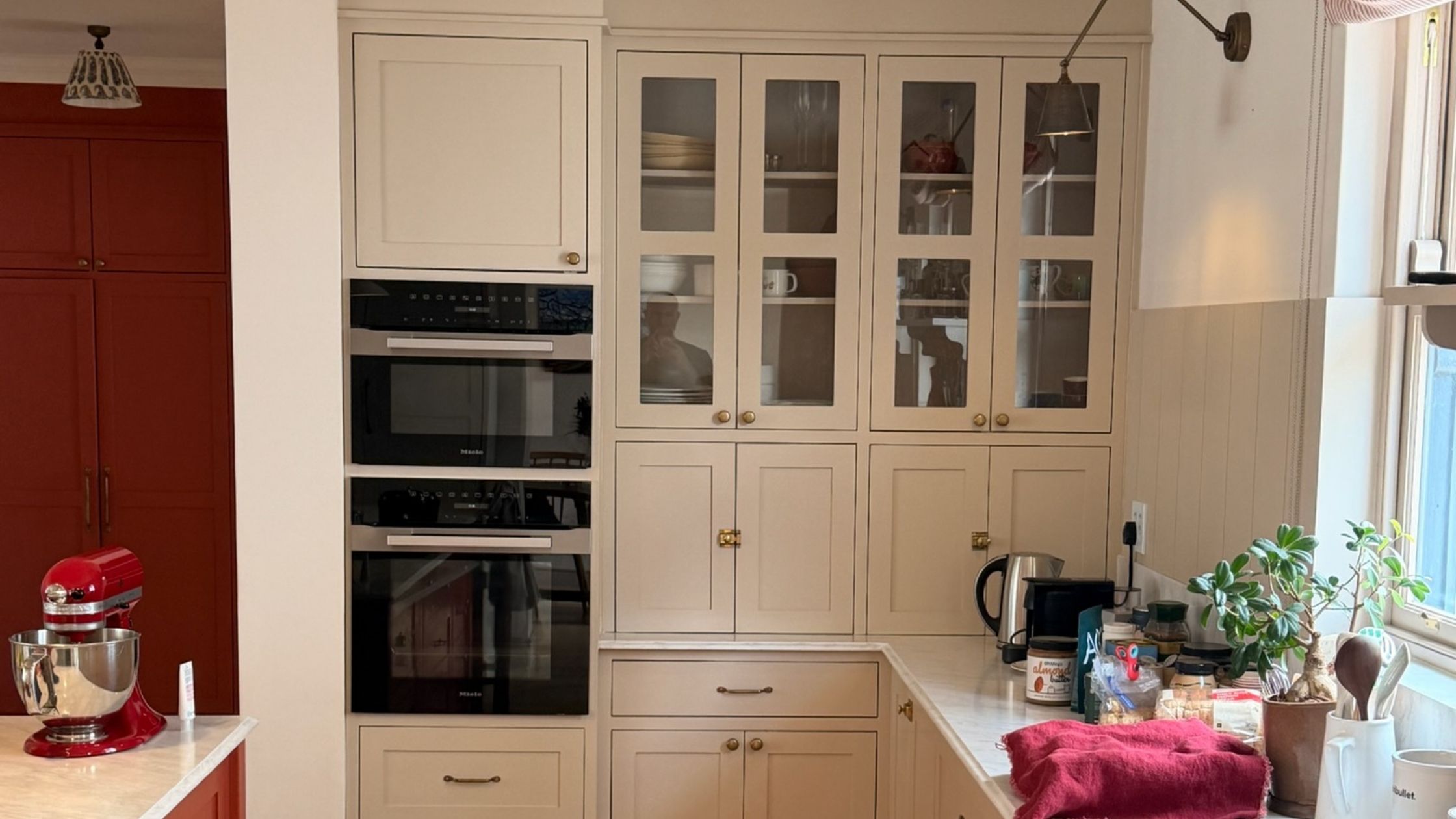
Custom kitchen cabinets in Cape Town are one of the most significant investments in any kitchen renovation. Get the specification right and you end up with a kitchen that works exactly the way you need it to, looks exactly the way you want it to, and lasts for decades. Get it wrong and you are living with the consequences every time you open a drawer. This guide covers everything you need to specify before a single panel gets cut.
Why Custom Kitchen Cabinets Cape Town Homeowners Choose Over Flat-Pack
Flat-pack and semi-custom cabinets come in fixed sizes. They are designed for standard kitchen layouts with standard ceiling heights and standard wall lengths. Most Cape Town kitchens, particularly in older homes across Rondebosch, Newlands, Milnerton, and Goodwood, do not have standard anything.
Custom kitchen cabinetry is built to the exact dimensions of your space. Floor to ceiling, corner to corner, around the pillar, above the window, into the alcove. Every centimetre is used. There are no filler strips, no awkward gaps, and no compromises introduced by forcing a standard unit into a non-standard space.
Beyond fit, custom cabinetry lets you specify the internal configuration from scratch. You are not choosing from a limited menu of what the manufacturer offers. You are designing the inside of each cabinet around how you actually cook and what you actually store.
Material Choices for Custom Kitchen Cabinets in Cape Town
The material your cabinets are built from determines their durability, their finish options, and their long-term performance in a working kitchen. Here is what to understand about each option before you brief your joiner.
MDF and Melamine Board
Medium-density fibreboard (MDF) is the most common substrate for painted kitchen cabinets. It is dimensionally stable, machines cleanly, and takes paint well when properly primed. Melamine-faced board is an MDF or particleboard core with a factory-applied melamine surface, available in a wide range of colours and woodgrain finishes.
Both are cost-effective and practical for most kitchen environments. The key consideration in Cape Town’s coastal areas is moisture management. MDF swells when exposed to prolonged moisture, which makes proper sealing and good waterproofing in wet zones essential.
Solid Timber
Solid timber cabinet doors and drawer fronts add warmth and character that no board product fully replicates. Timber also ages well, accepting refinishing and repair in ways that melamine cannot. However, solid timber moves with humidity changes, which requires careful joinery detailing and proper finishing to prevent warping over time.
In most custom kitchen cabinet projects, solid timber is used selectively for visible door and drawer fronts, with the cabinet carcasses built from more stable board products. This gives you the visual warmth of timber without the dimensional instability of an all-timber structure.
2PAC Lacquer Finish
A 2PAC (two-component polyurethane) lacquer finish is the premium option for painted kitchen cabinets. It produces an extremely hard, smooth, wipe-clean surface that is significantly more durable than standard paint finishes. It is available in any colour and in matte, satin, and gloss sheens.
The trade-off is cost. A 2PAC finish adds to the overall cabinetry price but delivers a result that standard paint cannot match in terms of durability or visual quality. For Cape Town homeowners investing in a kitchen renovation they intend to keep for ten or more years, 2PAC is frequently the right choice.
Hardware: Where Quality Matters Most
Cabinet hardware is the most tactile part of any kitchen. Every time you open a door or pull out a drawer, you feel the quality of the hinges and drawer runners. This is not where to save money.
Hinges
European concealed hinges from manufacturers such as Blum or Grass are the standard for quality custom kitchen cabinets. They are adjustable in three dimensions, soft-close as standard, and rated for tens of thousands of open-close cycles. Cheap hinges develop play within months. Good hinges last the life of the cabinet.
Drawer Runners
Full-extension, soft-close drawer runners give you access to the full depth of the drawer and close quietly and smoothly under their own mechanism. Side-mounted undermount runners from Blum or Hettich are the quality benchmark. Avoid bottom-mounted rollers and partial-extension runners on any cabinet you use daily.
Handles and Knobs
Handle selection is largely aesthetic, but the fixing method matters practically. Longer bar handles distribute pull force across two fixing points and are significantly more durable than single-point knobs on heavy drawer fronts. Specify the handle before the cabinetry is built so fixing holes are drilled in the factory, not on site.
Internal Fittings for Custom Kitchen Cabinetry in Cape Town
The internal configuration of your cabinets is where custom kitchen cabinetry in Cape Town earns its value over a flat-pack alternative. Standard cabinets give you a shelf and a rail. Custom cabinetry gives you whatever the space needs.
Common internal fittings to consider:
- Pull-out pantry units: tall, narrow cabinets with full-extension shelves that bring everything to the front. Far more practical than a fixed-shelf larder.
- Deep drawer stacks: for pots, pans, and bulky items. Three deep drawers below a countertop are often more useful than two doors and a shelf.
- Waste and recycling pull-outs: integrated bins that sit inside the cabinet and pull out with the door, keeping worktops clear.
- Corner solutions: le mans units or magic corners that make use of corner cabinet space that standard shelving leaves dead.
- Cutlery and utensil inserts: drawer dividers sized to what you actually own, not a generic tray dropped into a standard drawer.
- Integrated appliance housings: spaces designed and built to house your specific appliances — microwave, coffee machine, wine fridge — at the right height and with the right ventilation.
According to Houzz’s kitchen design research, storage functionality consistently ranks among the top priorities for homeowners undertaking kitchen renovations. Internal fittings are where that functionality is built in.
Countertop Compatibility: Specify This Before Cabinetry Is Built
The countertop material needs to be selected before cabinetry drawings are finalised, not after. Different materials require different support structures and substrate preparations.
- Engineered stone and granite: heavy materials that require a continuous, level substrate and adequate cabinet carcass support. Overhangs for seating need specific structural consideration.
- Solid timber countertops: need an expansion gap at walls to allow for seasonal movement. Cannot be fixed rigidly.
- Compact laminate: lighter than stone and more forgiving on substrate requirements, but still needs a flat, level carcass top.
The cutout positions for your sink and hob also need to be confirmed at drawing stage. Changing these after cabinetry is manufactured is expensive and sometimes impossible without remaking panels.
Questions to Ask Your Joiner Before Work Starts
Before signing off on any custom kitchen cabinetry brief in Cape Town, make sure you can answer these questions with your joiner:
- What board and substrate are you using for the carcasses, and what is the thickness?
- What hardware brand are you specifying for hinges and drawer runners?
- Are the drawer runners full-extension and soft-close?
- What is the edge banding specification on the board components?
- How are the carcasses fixed to the wall, and what is the levelling method?
- What is the lead time from drawing sign-off to delivery, and who manages installation?
A joiner who cannot answer these questions clearly has not yet thought the project through in enough detail. A joiner who answers confidently and specifically is one who has done this before.
How SK Projects Approaches Custom Kitchen Cabinetry in Cape Town
At SK Projects & Investments, custom kitchen cabinets are designed, built, and installed by the same team. Every project starts with a site measurement and a brief that covers how the client uses the kitchen, not just what they want it to look like.
We specify hardware from quality European manufacturers, use SABS-compliant board products, and build carcasses to tolerances that ensure doors and drawers sit and operate correctly once installed. You can see examples of our completed kitchen cabinetry work on the projects page, including the full kitchen renovation at 4 Oxalis Street, Milnerton.
Learn more about how we work on the Who We Are page.
Ready to Specify Your Custom Kitchen Cabinets in Cape Town
Custom kitchen cabinetry is a significant investment and the right one for homeowners who want a kitchen that works precisely for them and lasts for decades. The specification process is where that value is built in. Get it right before the first panel is cut and everything that follows is easier.
Book a Custom Kitchen Cabinetry Consultation
Thinking about custom kitchen cabinets for your Cape Town home? Book a free on-site consultation with SK Projects. We will measure your space, discuss your brief, and give you a clear picture of what is possible and what it will cost before you commit to anything.
Get in touch with SK Projects & Investments
Phone: 082 921 9190
Email: shaheen@skprojects.co.za
SK Projects & Investments is a registered member of the NHBRC (National Home Builders Registration Council).