
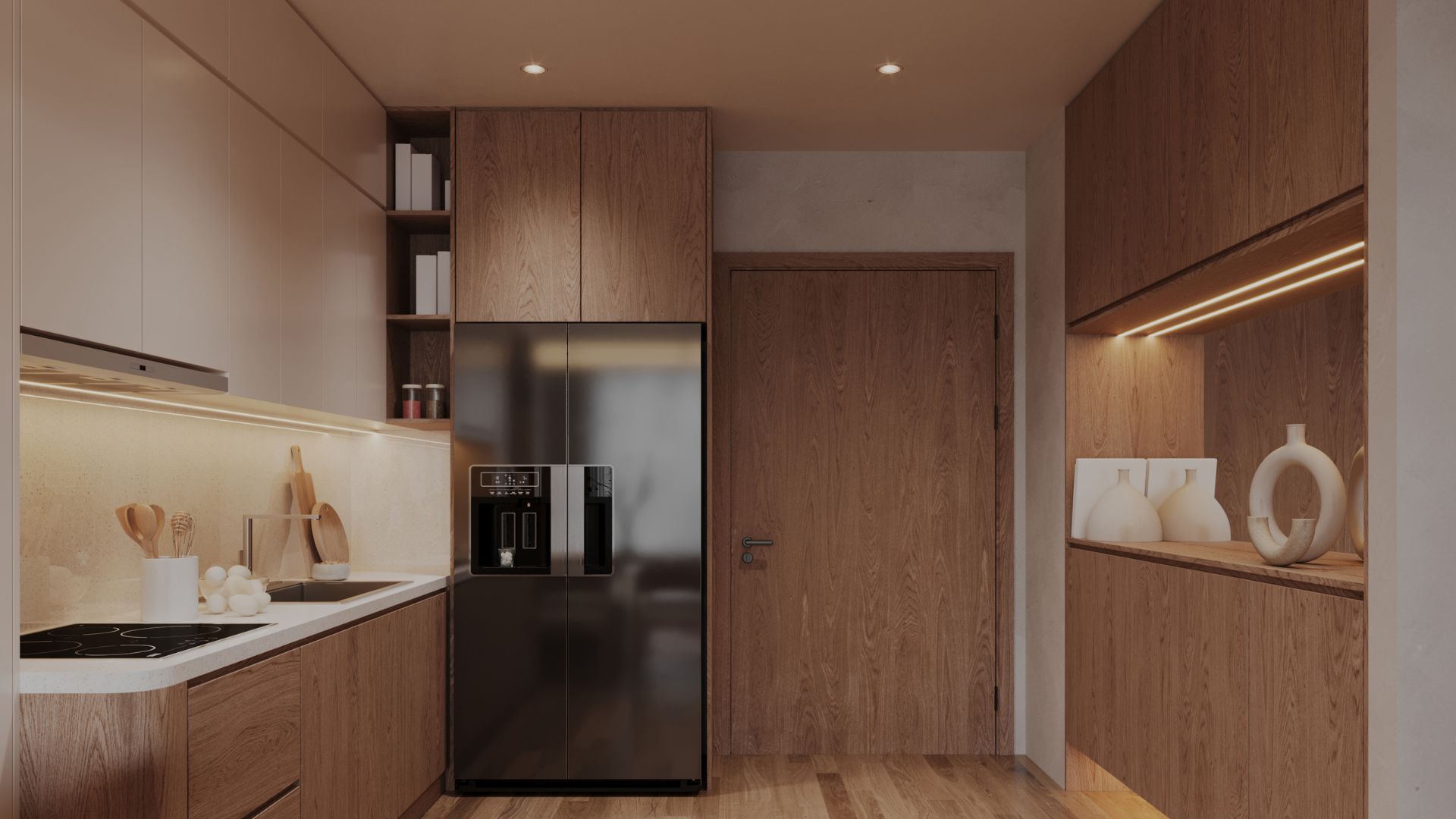
Walk into a home with well-made custom joinery and you feel it before you can name it. The kitchen cupboards sit flush with the ceiling. The wardrobe fills the alcove corner to corner. The drawer opens with a smooth, deliberate pull and closes without a rattle. Nothing is quite as immediately telling about the quality of a renovation as the woodwork — and nothing is quite as visible when it has been compromised.
The decision between custom joinery and off-the-shelf cabinetry comes up on almost every renovation project we work on. This guide breaks it down honestly — what the real differences are, where the value actually lies, and how to think about the choice for your specific home.
What Is Joinery, Exactly?
Joinery is the craft of joining timber and other materials to create fitted elements within a building — cabinets, wardrobes, kitchen cupboards, vanity units, shelving, window frames, doors, staircases, and built-in storage. It sits between carpentry (structural woodwork) and furniture-making (standalone pieces), and it is the discipline that gives a renovated home its polish and precision.
Custom joinery means every piece is designed, measured, built, and installed specifically for your space. Off-the-shelf or flat-pack alternatives — the kind sold at large home stores — are manufactured in standard sizes to fit the broadest possible range of homes, which inevitably means they fit none of them perfectly.
That distinction sounds simple. The downstream consequences of it are anything but.
The Fit Problem: Why Standard Sizes Always Compromise
Most rooms in Cape Town homes — particularly older properties in suburbs like Goodwood, Rondebosch, Newlands, and Milnerton — are not built to showroom dimensions. Walls are not always square. Ceilings are not always level. Alcoves have their own logic. A flat-pack kitchen designed for a 2,400mm ceiling in a standardised new build will leave a gap, require filler panels, or simply not reach when installed in a home with 2,700mm ceilings.
Those gaps are not just aesthetic. They collect dust. They look unfinished. And they are a constant reminder that the cabinetry was designed for someone else’s home.
Custom joinery is measured on-site before a single cut is made. Every dimension is specific to your room — ceiling height, wall angles, floor level, plumbing positions, and the natural irregularities of your existing structure. The result is cabinetry that disappears into the room, not cabinetry that is wedged into it.
The Materials Difference: What You’re Actually Buying
This is where the comparison between custom joinery and flat-pack becomes most stark.
Off-the-shelf cabinetry is typically constructed from:
- Particleboard or MDF (medium-density fibreboard) — compressed wood chips or fibres bonded with resin
- Thin melamine or paper veneer surfaces applied over the board
- Basic cam-lock or screw fixings for assembly
- Budget hardware with limited load capacity and lifespan
These materials are not inherently dishonest — they do a job at a price point. But their limitations show quickly in high-use environments. MDF swells when exposed to moisture. Particleboard loses its grip around screws over time, meaning hinges loosen, doors sag, and drawers stop sitting flush. Budget cam-lock fittings — the type you tighten with an Allen key during assembly — are not designed for decades of daily use.
Custom joinery is built from:
- Solid timber or high-grade plywood (which has real structural integrity, unlike particleboard)
- Applied timber veneers, lacquered 2PAC finishes, or solid wood faces
- Traditional joinery methods — dovetail joints, mortise-and-tenon connections — that create structural bonds without relying on hardware alone
- Quality European hardware from manufacturers like Blum and Hettich, engineered for hundreds of thousands of open-close cycles
The structural difference matters enormously in a kitchen or bathroom, where cabinetry faces daily heat, steam, cleaning products, and weight. Solid timber and quality plywood resist warping and maintain their structural integrity in ways that particleboard simply cannot over a multi-decade lifespan.
The Longevity Calculation
Off-the-shelf cabinetry often needs significant repair or full replacement within five to ten years in a busy kitchen. Hinges are replaced, drawer slides are adjusted, faces start delaminating. Some homeowners cycle through two or three flat-pack kitchens in the time a single custom installation would last.
Well-built custom joinery, by contrast, is designed to outlast the renovation itself. The joinery techniques used — dovetail joints and mortise-and-tenon connections — are the same ones used by craftsmen for centuries precisely because they create bonds that strengthen under load and use, rather than weakening.
When you account for the full lifespan cost — including replacements, repairs, and the disruption of redoing a kitchen ten years down the line — the investment in custom joinery often costs less than the cheaper alternative.
Design Freedom: Your Space, Your Brief
Flat-pack cabinetry is designed for mass appeal. The range is broad, but within it, your options are constrained by what the manufacturer decided would sell widely enough to justify production.
Custom joinery starts from a blank brief. Want floor-to-ceiling cabinetry that maximises a 3-metre wall? Done. A kitchen island with integrated seating, deep pot drawers, and a built-in wine rack? Designed around how you actually cook. A bathroom vanity with specific internal compartments for your bathroom routine? Measured, drawn, and built to fit.
This design freedom extends to materials and finishes. Timber species, lacquer colours, handle styles, internal fittings, soft-close mechanisms, integrated lighting — all of it is chosen for your home, not selected from a catalogue of what happens to be available this season.
For Cape Town homes specifically, this matters. Heritage properties in the Southern Suburbs often have architectural details — cornicing, ceiling roses, non-standard ceiling heights — that demand joinery that works with the building rather than against it. Modern open-plan homes in Milnerton or Camps Bay have their own spatial logic. Custom joinery in Cape Town is not a luxury item — it is the practical solution for homes that do not conform to the box-store template.
The Property Value Argument
If you are renovating with an eye on resale — or simply maintaining the value of a significant asset — the quality of your joinery is worth understanding from a property perspective.
RE/MAX South Africa notes that improvements that add functional space and enduring quality tend to hold their value longer than cosmetic upgrades. A kitchen with custom cabinetry built to last reads differently to a buyer than one with flat-pack that is already showing wear — even if both looked similar on installation day.
The specific contribution of joinery to resale value depends on the suburb, the buyer, and the overall quality of the home. But the general principle holds: well-executed, high-quality finishes signal care and craftsmanship to the market in a way that mass-produced alternatives do not.
For homeowners using renovation as a deliberate value-creation strategy — particularly those doing full home transformations or investment flips — this distinction between quality and convenience is not incidental. It is part of the brief.
When Off-the-Shelf Makes Sense
To give a complete picture: flat-pack cabinetry has its place. A rental investment property where the brief is functional and cost-controlled, a garage workshop, a utility room, or a short-term rental that needs to be furnished quickly — these are contexts where the cost savings of off-the-shelf are proportionate to the purpose.
The problem comes when that same cost-driven logic is applied to the kitchen of a family home, the wardrobes of a master bedroom, or the vanity of a bathroom that gets used three times a day by multiple people. In those spaces, the quality of the joinery shapes the quality of daily life in the home — and the investment in getting it right is measured in years, not months.
What the SK Projects Joinery Process Looks Like
At SK Projects & Investments, our joinery work begins with a site visit and measurement — not a catalogue. We design cabinetry around the actual dimensions and conditions of your room, coordinate with the other trades on the project (tiling, plumbing, electrical), and build and install with the same team that designed it.
This matters because the handover between design and installation is where most joinery projects lose their precision. When one team designs, another builds, and a third installs, something is always lost. Our approach keeps accountability in one place from concept to sign-off.
You can see this in practice across our completed projects — from the custom kitchen and cabinetry work at 4 Oxalis Street in Milnerton to the full joinery, flooring, and finish work on the 6th Avenue transformation in Boston. Every one of those spaces was measured, designed, and installed specifically for that home.
Whether you are planning a full kitchen renovation, a master wardrobe fit-out, custom bathroom vanities, or bespoke built-in storage, our joinery and cabinetry service is built around your space, your brief, and your timeline — not a standard range.
The Short Answer
Off-the-shelf cabinetry is a compromise. Sometimes that compromise is the right call for the context. In your home — in the spaces where your family lives every day — custom joinery in Cape Town is the version of quality that holds its shape, its precision, and its value over the long term.
The difference is not always visible on installation day. It becomes visible over time: in the drawer that still runs smoothly after ten years, in the kitchen that has not needed touching since it was built, in the home that buyers notice when they walk through the door.
Talk to SK Projects About Custom Joinery for Your Home
We work with homeowners across Cape Town — from Rondebosch and Newlands to Camps Bay, Milnerton, and beyond. If you are planning a kitchen renovation, wardrobe fit-out, or any cabinetry project and want to understand what custom joinery would look like for your specific space, we would be glad to walk through it with you.
Book a free site visit and consultation.
📞 082 921 9190 ✉️ shaheen@skprojects.co.za
SK Projects & Investments — NHBRC-registered builders and custom joinery specialists delivering kitchens, cabinetry, wardrobes, and bespoke timber work across Cape Town since 2018.