
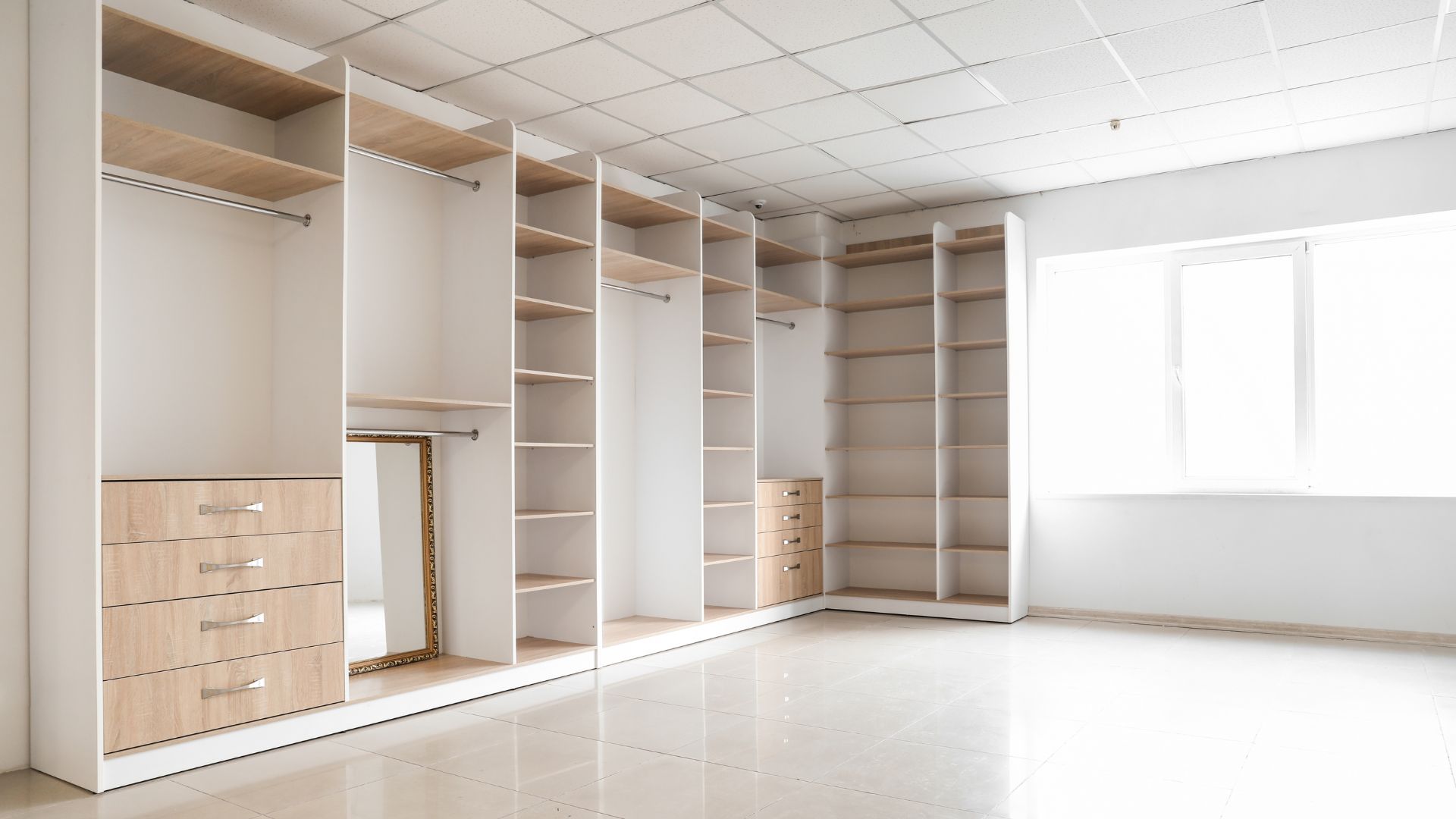
Choosing between built-in wardrobes and freestanding units is a decision that plays out every single day in your home. For Cape Town homeowners, built-in wardrobes offer a level of space efficiency and customisation that freestanding units simply cannot match — particularly in older properties where rooms rarely follow standard dimensions. Both options have their place, but understanding the difference is what gets you to the right choice for your specific situation.
What Is the Actual Difference
A built-in wardrobe is a custom-designed, permanently fitted storage solution. It is measured and built for your specific wall, ceiling height, and floor level — no gaps, no fillers, no compromises. Once installed, it becomes part of the room.
A freestanding wardrobe, by contrast, is a standalone pre-manufactured unit purchased at a set size. It can be moved, repositioned, or taken with you when you leave. It does not require installation by a joiner and goes up relatively quickly.
These two options serve fundamentally different purposes. Understanding which purpose fits your situation is the whole point of this guide.
Space: Where Built-in Wardrobes in Cape Town Win Every Time
The single biggest practical advantage of a built-in wardrobe is what it does with space — specifically, the space that freestanding wardrobes waste.
A freestanding unit sits in front of a wall. It has a fixed depth, a fixed width, and a fixed height. If your ceiling is higher than the unit, there is dead space above it. If the wall is longer, there is dead space beside it. Corners go unused. Awkward alcoves stay awkward.
Built-in wardrobes work around your room — floor to ceiling, wall to wall, into the corner, around the chimney breast, under the eave, into the slope. Every centimetre serves a purpose. In Cape Town homes — particularly older properties in Rondebosch, Newlands, Goodwood, and Milnerton where rooms often have high ceilings and non-standard layouts — this matters enormously.
For smaller bedrooms especially, the difference between built-in and freestanding is often the difference between a room that functions well and one that does not.
Customisation: Your Room, Your Routine
Freestanding wardrobes come in a range of styles and finishes, but their internal configuration is fixed or limited — a rail here, a shelf there, a set of drawers if you choose that model.
Custom cabinetry in Cape Town starts from a blank brief. The internal layout of built-in wardrobes is designed around how you actually use the space:
- Long hanging space for dresses and suits
- Short rails with stacked drawers for folded items
- Shoe shelves sized for your collection
- Pull-out trouser racks, jewellery compartments, integrated lighting
- Mirror panels built into the door faces
- Soft-close mechanisms on every drawer and door
The finish, the colour, the handle style, the door type — hinged or sliding — all of it is chosen to suit the room and the rest of the home. The result is cabinetry that feels like it was always there, not furniture that was moved in.
For heritage properties with cornicing, non-standard ceiling heights, or angled walls beneath a roofline, custom built-in wardrobes in Cape Town are often the only solution that works without visible compromise.
Durability: What You Are Paying For
This is where the comparison becomes most relevant to long-term value.
Most freestanding wardrobes at accessible price points use particleboard or MDF with melamine facing, assembled with cam-lock fittings and basic hinges. These materials do a job. However, in a busy bedroom — with daily opening and closing, weight on rails, and drawers pulled in and out repeatedly — their limitations show within a few years. Hinges loosen. Drawer bases flex. Doors stop sitting flush.
Custom built-in wardrobes use higher-grade materials — solid timber components, quality board products, and European hardware engineered for tens of thousands of open-close cycles. Furthermore, installation happens with the same precision as the build. There are no alignment issues from self-assembly and no structural weaknesses from flat-pack construction.
A well-built built-in wardrobe, properly installed, will outlast multiple generations of freestanding alternatives in the same room.
There is also a safety consideration worth raising. Freestanding wardrobes — particularly lighter-framed units — carry a real risk of toppling, especially in homes with young children. Built-ins fix to the wall and floor, which eliminates this risk entirely.
Cost: The Honest Comparison
Freestanding wardrobes cost less upfront. That is a straightforward truth, and there is no point pretending otherwise.
The real question, however, is what you are comparing over time. A freestanding unit that needs replacing within five to seven years — plus the cost of that replacement — is not necessarily cheaper than a built-in that lasts twenty years without intervention. The full lifespan cost often tells a different story to the purchase price.
What drives the cost of custom cabinetry in Cape Town:
- Materials — melamine and MDF are the entry point; solid timber and high-gloss finishes carry a premium
- Size and configuration — floor-to-ceiling, walk-in, and multi-bay installations cost more than a single-wall fit-out
- Internal fittings — pull-out hardware, soft-close mechanisms, and integrated lighting all add to the brief
- Finish — lacquered 2PAC, timber veneer, and custom colour finishes sit above standard board options
A reputable joinery company will give you a detailed quote after measuring your space — not a per-linear-metre estimate pulled from a price sheet. If a quote arrives before anyone has visited your property, treat it accordingly.
Resale Value: What Buyers Actually Notice
Built-in storage consistently ranks among the features buyers look for when viewing a property. According to Private Property, effective utilisation of space is becoming a primary factor in homebuyer decision-making — particularly as demand for smaller, well-designed homes grows.
A bedroom with custom built-in wardrobes signals something to a buyer: this home has been thoughtfully finished. The storage is already solved. The room looks considered. That impression carries value — both in how quickly a property sells and in the asking price it supports.
Freestanding wardrobes, by contrast, leave with the owner. They add nothing to the property’s value at the point of sale. A built-in stays — and a good one adds to the appeal of the space for every buyer who walks through.
That said, as RE/MAX South Africa advises, the return on any renovation depends on the broader market, the suburb, and the overall quality of the home. The point is that built-ins contribute to value; freestanding units do not.
When Freestanding Makes Sense
For completeness, there are situations where a freestanding wardrobe is the practical answer.
If you are renting, a built-in is not yours to install. If you are in a short-term living arrangement, the flexibility of a unit you can take with you has real value. Similarly, if you are furnishing a utility bedroom on a constrained budget, the cost savings of freestanding are proportionate to the context.
The problem arises when freestanding logic is applied to the master bedroom of an owned family home — a space used every day, by multiple people, for decades. In that context, the short-term cost saving is rarely worth the long-term compromise.
The SK Projects Approach to Built-in Wardrobes in Cape Town
At SK Projects & Investments, every cabinetry project starts with a site visit and a proper measurement — not a catalogue selection. Every built-in wardrobe we design is specific to the room it will live in, the person who will use it, and the style of the home it belongs to.
We design, build, and install with the same team. That single point of accountability — from first measurement to final fitting — keeps precision in the process and removes the gaps that emerge when design, manufacturing, and installation are split between different contractors.
Our built-in wardrobes and custom cabinetry work sits alongside our broader renovation offering — kitchens, bathrooms, extensions, and full turnkey builds. You can see examples of our completed work on the projects page, including the full joinery and finish work from our 6th Avenue Boston and 4 Oxalis Street Milnerton builds.
Ready to Fit Out Your Bedroom
Built-in wardrobes in Cape Town start with a conversation and a site visit. We look at your room, understand how you use the space, and give you an honest picture of what is achievable, what it will involve, and what it will cost — before you commit to anything.
Learn more about how SK Projects works on the Who We Are page, or read about our full renovation services on the trusted experts page.
Book a Free On-Site Consultation
Thinking about fitted storage for your home? Book a free on-site consultation with SK Projects. We will assess your space, discuss layout and configuration options, and provide a realistic budget estimate — before you commit to anything.
Get in touch with SK Projects & Investments
Phone: 082 921 9190 Email: shaheen@skprojects.co.za
SK Projects & Investments is a registered member of the NHBRC (National Home Builders Registration Council).